|
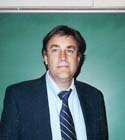
Ken Jones is the founder and president of PSS. He has
authored the book and software package as well as dozens of research
papers. Portfolio Management is a quantitative
investment book published by McGraw-Hill in 1992. PSS
Release 2.0: with the Digital Portfolio
Theory™ optimization engine is a state of the art software
package published in 1997. This new approach enables the user to find
optimal diversified portfolios of investments while controlling calendar,
systematic and fundamental risk. Professor Jones has been actively pursuing
research in applying digital signal processing to the portfolio network
model to solve the portfolio selection problem since 1982.
In 1984 Ken attended the American Finance Association conference in
New York City. "I was an enthusiastic new Ph.D. student. I took my working
paper describing the benefits to portfolio theory of describing risk
in a signal processing framework. I was anxious to get comments on my
idea so I went to Harry Markowitz's room. Unfortunately he was not in
his hotel room so I left the paper with a note. I was pleasantly surprised
that evening when Professor Markowitz called and said he was interested
in my paper and suggested we meet for breakfast the following morning.
The next morning I meet the very tall, friendly unassuming professor
and he suggested we eat in a small coffee shop across the street from
the hotel. We had fried eggs and I explained to Harry that by defining
risk in signal processing terms not only did you add a time dimension
to his portfolio selection model but the non-linear portfolio selection
problem became a linear programming problem as well. He was quite encouraging
and inspired me to continue my research. From then on I continually
solicited his comments and he never failed to comment and provide information
about his own research. If anyone ever deserved the title of "Father
of Finance" it is Harry Markowtiz, always supportive, always encouraging
as we would expect a true father to be.
At breakfast Markowtiz confided in me that he considered himself first
and foremost a management scientist. Although I was a finance Ph.D.
student at the University of Colorado in Boulder, I had the good fortune
to have Professor Fred Glover, the well know management science professor
and expert in network optimization on my dissertation committee. In
fact I had conceived of my proposed model while reading a working paper
using network techniques to solve asset allocation problems written
by Professor Bruce Golden and K.D. Keating at the University of Maryland.
I had arrived in Boulder a couple of weeks before school started to
get a start on my dissertation. I went into Professor Glover office
and he gave me some of the working papers he had littered about his
office that related to finance. The paper attempted to apply the deterministic
network model to single and multiple period portfolio theory. I was
living at a campsite since I had not found an apartment yet for the
school year. I remember sitting at a picnic table with a view of the
Boulder's shear rock cliffs, I was reading the paper and suddenly my
engineering background kicked in and I saw the money flowing through
the portfolios as the motion of electrons." Dr. Jones realized that
the monetary flow in the portfolio networks could be made stochastic
by using the frequency domain description of risk. The network optimization
problem under uncertainty would remain the same as the deterministic
problem except for additional flow conservation constraints on risk
that could be derived using phasor algebra.
Both Arthur Roy and M.F.M. Osborne went from the military profession
of gunnery to the field finance. Arthur Roy simultaneously presented
the portfolio theory model with Markowitz in 1952. M.F.M. Osborne was
a physicist who applied the concept of Brownian motion to the stock
market in 1959. Paul Samuelson also worked on radar servomechanisms
for fire control against aircraft for the Navy during World War II.
Similarly Ken Jones' designed missile fire control systems to protect
Navy destroyers from missile attack from the Russian SAM missiles after
completing his undergraduate Engineering degree at the University of
Michigan during the Vietnam War.
Following the Vietnam war Ken traveled in Europe and North Africa. With
a friend he started a business importing sheep skin coats form Turkey
for sale in Heidelberg, Germany and Innsbruck, Austria. Upon his return
to the US he became a Ph.D. student in mathematics at Carnegie-Mellon
University in Pittsburgh. After deciding to forgo a career in mathematics
he began working for Carnegie-Mellon University's computer center. Here
he wrote his first book titled "How to Debug Fortran Programs using
System Dumps." In addition, he was in charge of the Carnegie's hybrid
computer center (a combined analog and digital computer)

Following his work at Carnegie-Mellon University, Ken Jones became a
system analyst for the Midwest Stock Exchange in Chicago designing computer
software for security order execution and confirmation between brokerage
houses and their brokers on the exchange floor. Finding Chicago friendly
but too cold in winter he applied for and received a scholarship to
do an MBA degree at the University of Florida. At Florida he became
Professor Eugene Brigham's research assistant for 2 years. In this capacity
he had extensive experience doing financial empirical studies using
CRSP and Compustat security data bases.
Upon finishing his MBA in Finance from the University of Florida, Ken
took time out for a trip around the world before beginning work on a
Ph.D. in finance at the University of Colorado. He traveled by bus from
Amsterdam to India and then to Nepal continuing to Thailand, Hong Kong,
Korea and Japan. In India he became interested in yoga and continues
to be a practitioner and student of yoga to the present day. At the
University of Colorado in Boulder he met Professor Fed Glover, a well
known researcher in operations research. Fred served as a member on
Ken's dissertation committee. Ken's dissertation presented the stochastic
portfolio network optimization model and derived Digital Portfolio
Theory for the first time. Since completing his Ph.D. in finance
Ken has devoted his research and efforts to promoting and enhancing
this new theory of financial signal processing.
Professor Jones has served as visiting professor at the University of
Delaware, Department of Finance. He was Amoco Chair Professor of Management
in the School of Business, at the American University in Cairo for three
years. He previously held appointments at the University of Florida
in Gainesville, and at the University of Petroleum & Minerals in Saudi
Arabia. He teaches courses in Portfolio Management, Investments, Derivatives,
International Finance, and Corporate Finance.
Ken Jones is the most innovative and penetrating researcher in the field
of financial theory in America today.
|